
Dish guide ·
Laing: The Filipino Taro Leaf Dish From Bicol
Laing is dried taro leaves simmered in coconut milk with chilli and ginger until the sauce thickens, a Bicol dish that costs AED 37 at Pinoy Tambayan. It is one of nine vegetable rows on the menu and one of the few named by diners in their own reviews.
Laing is a Bicol dish of dried taro leaves, dahon ng gabi, simmered in coconut milk with chilli, ginger, garlic and onion until the leaves collapse into a thick dark sauce. At Pinoy Tambayan in Al Barsha 1, Dubai, it sits in the Gulay at Iba Pa group of the main dishes, which means one rice comes with it.
Dried leaves, not fresh ones
The taro leaves are dried before they are cooked, and that is not a shortcut. Drying concentrates the flavour and lets the leaf hold its shape through a long simmer in fat, which is why laing arrives as recognisable ribbons of leaf rather than a green puree. Fresh taro leaves belong to a different Bicol dish, pinangat, where whole leaves are folded into parcels around a filling and steamed upright in the pot. Laing is the shredded, dried, slow simmered version. The two are cousins rather than one recipe under two names, and a Bicolano will correct you if you swap them.
Why nobody stirs the pot
Taro leaves carry needle shaped calcium oxalate crystals, and those are what make an undercooked leaf scratch the back of your throat. Filipino cooks answer this with two rules learned in the same kitchen: cook the leaves right through in simmering coconut milk, and leave the spoon alone until they have softened and the milk has reduced. Stirring early breaks the leaves up before the crystals have broken down, which is the usual reason somebody ate a makati, an itchy laing, once and decided the dish was not for them. Cooked properly there is no scratch at all, only leaf and coconut.
How hot it actually is
Bicol is the chilli end of Filipino cooking, so the honest answer is that laing carries heat, but the chilli is seasoning rather than the point of the dish. The comparison worth making is with Bicol Express, the other famous coconut dish from the same region, which is built on chillies as its main ingredient rather than as a flavouring. Bicol Express in its usual form is also a pork dish. No pork is served at Pinoy Tambayan, which is one reason laing is the Bicol dish on our printed menu and Bicol Express is not.
What sits on top of ours
Look at the bowl before you start on it. Ours comes finished with whole prawns, sliced green finger chilli and raw onion rings laid over the leaves, and that plating decides two practical things. The chilli sits on top rather than blitzed through the sauce, so it can be lifted off for anyone at the table who does not want it. The prawns make this a vegetable dish rather than a vegetarian one, so anybody avoiding shellfish should say so when the order goes in.
It is a rice dish, whatever the menu calls it
Laing is AED 37 and every main dish comes with one free rice, which is exactly the arrangement this dish needs. It is a thick, salty, coconut heavy sauce, and rice is what it is for. Filipinos eat it in small spoonfuls against a lot of rice rather than as a bowl on its own, so a portion that looks modest next to a soup will feed more people than it appears to. Garlic rice, sinangag, is a separate row on the menu if you want the fried garlic version instead of plain.
What to order alongside it
- Something fried and salty. A whole fried fish against a coconut sauce is the classic contrast, and daing na bangus is the one that turns up beside laing most often in our own reviews.
- Something grilled. Charcoal grilled chicken, listed on the menu as Grilled Chicken, Filipino style, brings smoke that the coconut has none of.
- Noodles and beans. One of our Google reviewers names pancit bihon, laing and monggo together as the three to try, which is a standard Filipino household combination: a noodle, a vegetable and a bean.
- The other gata dish. Adobong manok sa gata puts the same coconut milk against vinegar rather than against leaves, so ordering both in one sitting shows what gata does to two dishes that share nothing else.
The rest of the vegetable rows
Laing is one of nine vegetable led rows in the Gulay at Iba Pa group, which is the part of the menu most first time visitors never reach. The three below are where people go next. Ginataang gulay is the other coconut milk vegetable dish, squash and beans in gata rather than leaves. Pakbet appears twice, in a Tagalog and an Ilokano version, and the two are cooked differently enough to be worth ordering separately. Chopsuey is the mild stir fry to put on the table when children are eating.
It travels better than most things we cook
Laing is a reduced sauce with nothing crisp in it, so there is nothing to go soft on the way to you and nothing that has to be eaten within ten minutes to be worth ordering. That makes it one of the safer things to put in a delivery bag on a hot afternoon. Send the order on WhatsApp, riders run 11:30 in the morning to 10:30 at night, and delivery is free within 5 km and AED 5 beyond, with no minimum order.
Laing for thirty people
On a party or office spread, laing is a useful tray because it holds its temperature, it does not dry out under a lid, and it gives the table a vegetable dish with real weight instead of a side salad nobody touches. Catering starts at AED 49 a head with a minimum of thirty people, and the vegetable course is usually the thin part of a Filipino spread when nobody planned it.
Who orders it here
Six of the 458 written five star reviews in our Google export of 23 August 2026 name laing, which is a lot of attention for one vegetable row on a menu of eighty two. Two of those six are written in Filipino, and one names laing as the thing that makes the writer miss Bicol. This is not a dish people order by accident off a photograph. It is ordered by people who already know what it is, and by people from the region that invented it.
Laing questions we get asked
What is laing?
Dried taro leaves simmered in coconut milk with chilli, ginger, garlic and onion until the leaves soften into a thick sauce. It comes from the Bicol region of the Philippines and is eaten with rice.
Is laing spicy?
It carries heat, but chilli is a seasoning here rather than the main ingredient. Ours is finished with sliced green chilli on top, which can be lifted off before anyone eats.
Is laing vegetarian?
No, not the way we serve it. The bowl is finished with prawns on top, so tell us when you order if you are avoiding shellfish.
What is the difference between laing and Bicol Express?
Laing is built on taro leaves, with chilli as seasoning. Bicol Express is built on the chillies themselves, and in its usual form it is a pork dish. No pork is served at Pinoy Tambayan, so laing is the Bicol dish we cook.
Why do taro leaves make your throat itch?
Because they were undercooked. Raw taro leaf carries calcium oxalate crystals, and simmering the leaves right through in coconut milk without stirring breaks them down. That is why laing is cooked slowly and left alone in the pot.
How much is laing, and does it come with rice?
Laing is AED 37 on the printed menu, and every main dish comes with one free rice. Plain rice and garlic rice are separate rows if you want extra.
Does laing survive delivery?
Yes. It is a reduced sauce with nothing crisp in it, so nothing goes soft on the way. Delivery is free within 5 km of Al Barsha 1 and AED 5 beyond, with no minimum order.
We are opposite Dubai International Academy in Al Barsha 1, open 9:00 AM to 1:00 AM every day, rated 4.5 on Google. Order laing with rice and something fried beside it, which is how it is eaten at home.
More from the Dining Guide
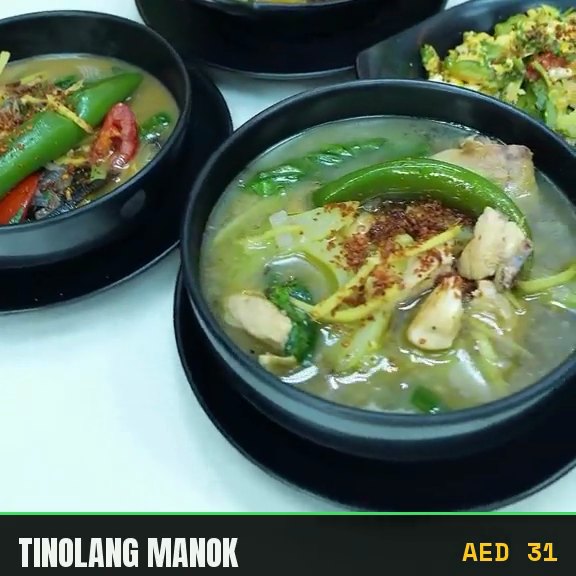 Tinolang Manok: Filipino Ginger Chicken SoupTinolang manok is chicken simmered in a clear broth built on ginger, garlic and onion, with a green vegetable and leaves added at the end. It is AED 31 at Pinoy Tambayan, the cheapest of the nine soup rows on the menu, and the dish Filipino households cook when somebody is unwell.
 Filipino Desserts at Pinoy Tambayan: Ube Halaya to Leche FlanPinoy Tambayan keeps six desserts on the printed menu at Al Barsha, from a five-dirham ice cream cone to a nineteen-dirham leche flan, plus halo halo as a seventh on its own guide. Every price and dish name below comes straight off the menu, not a guess.
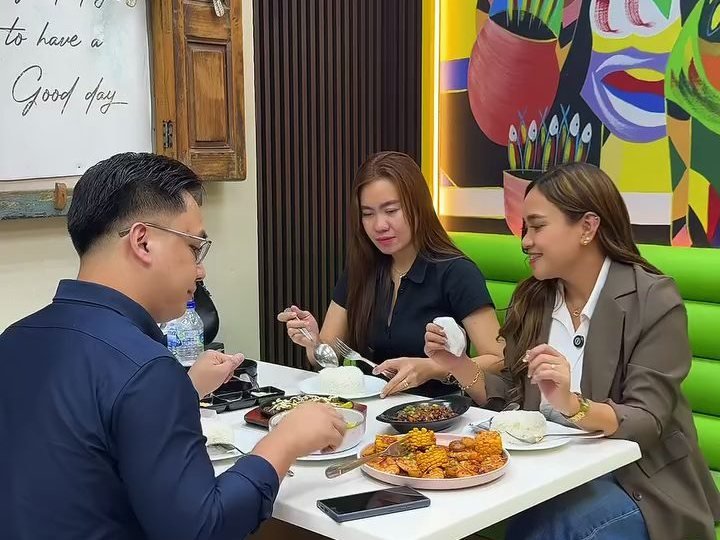 What Tambayan Means, and How to Find the Right Pinoy TambayanTambayan is Tagalog for a hangout, a place a group keeps returning to. There is more than one Pinoy Tambayan in Dubai and more than one thing online carrying the name, so here is what the word means and how to reach the one in Al Barsha.
Hungry now?
Open daily, 9:00 AM to 1:00 AM. No pork is served at Pinoy Tambayan. Free delivery within 5 km, AED 5 beyond, and no minimum order.
Order laing on WhatsApp +971 4 328 2669 Book a table Get directions