
Dish guide ·
Adobo Explained: The Vinegar and Soy Dish Filipinos Cook Weekly
Adobo is meat simmered in vinegar, soy sauce, garlic, bay leaf and black pepper. It is a preserving method rather than a fixed recipe, which is why no two Filipino families make it the same way.
Adobo is a Filipino cooking method in which meat is simmered in vinegar and soy sauce with garlic, bay leaf and cracked black peppercorns until the sauce reduces and the meat takes the acidity. It is the dish most often called the unofficial national dish of the Philippines, and it is a technique rather than a recipe: the ratio of vinegar to soy, whether sugar goes in, and how far the sauce is reduced all change from one household to the next. At Pinoy Tambayan in Al Barsha 1, Dubai, we cook two versions of it.
A method, not a recipe
Ask ten Filipinos how adobo is made and you will get ten answers that are all correct. Some brown the meat first and some do not. Some add sugar to round the vinegar, some add potato, some finish it in the oven until the edges catch. What makes it adobo is the acid and the salt working together: vinegar for the sourness and the keeping, soy sauce for the salt and the colour, then garlic, bay and pepper. Everything else is a household preference, which is why the argument about the correct version never ends and never needs to.
The vinegar came first, the Spanish name came later
Cooking meat in vinegar was already standard practice across the Philippine islands before Spanish contact, for the ordinary reason that a hot, humid country without refrigeration needs a way to keep cooked meat edible for days. Spanish colonisers met the technique and recorded it with their own word, adobar, meaning to marinate, and the name stuck to a dish that had not needed one. That order matters: adobo is not a Spanish recipe that arrived, it is an indigenous preserving method that acquired a Spanish label.
The rule about not stirring
The one instruction almost every Filipino cook was given by a grandmother: when the vinegar goes in, let it come to a boil before you stir. Raw vinegar stirred through a hot pan throws its harshest volatile acids straight into the sauce, and boiling first drives those off and leaves the rounder sourness behind. It is the difference between an adobo that tastes sharp and one that tastes deep, and it costs nothing except two minutes of leaving the spoon alone.
The two adobos on our menu
Both are chicken, and both sit in the Adobo at Klasiko section of the printed menu. Rice is listed with them below because adobo without rice is a sauce with nowhere to go.
What coconut milk does to it
Adobong manok sa gata is the same dish with coconut milk stirred in near the end, and the change is bigger than it sounds. The fat in the gata rounds off the vinegar, so the sourness reads as depth instead of a sharp edge, and the sauce thickens into something that coats rice rather than running off it. Southern Luzon, particularly the Bicol region, cooks it this way as a matter of course, and the same region gives us laing, where the gata goes over dried taro leaves instead of chicken. If you find straight adobo too sour on a first try, this is the one to order instead, and plenty of regulars never go back.
Why ours is chicken
Adobo abroad is often made with pork, or with pork and chicken together. No pork is served at Pinoy Tambayan, so both of ours are chicken, cooked the same way and reduced the same amount. Chicken adobo is not a substitute version: adobong manok is a standard of the dish in its own right across the Philippines, and the thigh meat holds up to a long simmer in acid better than most cuts do.
The regional versions you may have eaten
- Adobong puti, white adobo: vinegar, garlic and salt with no soy sauce at all, and closer to the pre-colonial original than the dark version most people picture.
- Adobo sa gata: coconut milk stirred in at the end, associated with the Bicol region and southern Luzon. This is the one on our menu.
- Adobong dilaw, yellow adobo: turmeric instead of soy, a Batangas habit, and the reason some adobo arrives at the table golden rather than brown.
- Adobo flakes: leftover adobo shredded and fried until crisp, then served over garlic rice with an egg for breakfast.
- Adobong kangkong or sitaw: the same method applied to water spinach or long beans, which is how the technique moves into vegetables.
Day two adobo is a real thing
Adobo genuinely improves overnight, and Filipinos will tell you so before you have finished the first plate. The acid keeps working into the meat after the pan comes off the heat, the fat and the sauce separate and recombine, and the sharp top notes settle. This is also why it travelled: an adobo cooked on Sunday was still safe to eat on Wednesday in a house with no fridge, and it was the standard baon, the packed meal, for anyone leaving home for work or a long journey. If you order it for delivery and only get through half, you have not wasted anything.
How to eat it properly
- Rice first, sauce over it. The sauce is the dish and the meat is the vehicle, whatever the menu photo suggests.
- Garlic rice, sinangag, is worth the upgrade here. Fried garlic against vinegar is the whole point of Filipino breakfast, and it works the same way at dinner.
- Eat the bay leaf around, not through. It goes in for perfume and comes out fibrous.
- A fried egg on top is normal and nobody will find it strange, especially if you are ordering it at breakfast time. The silog sets work on exactly that logic.
- If it arrives sharper than you expected, more rice fixes it faster than anything else on the table.
Adobo for a table, and for a crowd
Adobo is a sharing dish by design: one pot in the middle, everyone spooning it over their own rice. For a group in the restaurant, order both versions and let people compare the plain against the gata, which is a better introduction than describing the difference. For thirty people or more we cook it as part of a catering spread, where the fact that it holds and improves rather than degrading over an hour makes it one of the easier dishes to serve at scale.
First time ordering Filipino food?
Adobo is the safest possible entry point, because there is nothing unfamiliar in it: soy sauce, vinegar, garlic and pepper are in every cuisine, and the technique is just a slow braise. If you want the wider first order rather than a single dish, we set out five things to order on a first visit, and adobo earns its place on that list for exactly this reason.
Adobo questions we get asked
What is Filipino adobo?
Meat simmered in vinegar and soy sauce with garlic, bay leaf and black peppercorns until the sauce reduces. It is a preserving method as much as a recipe.
Is adobo the national dish of the Philippines?
It is widely called the unofficial national dish. The Philippines has never formally designated one, which is part of why the argument is so enjoyable.
What is the difference between adobo and adobo sa gata?
Coconut milk. Adding gata near the end rounds off the vinegar and thickens the sauce, so it tastes deeper and less sharp.
Do you make pork adobo?
No pork is served at Pinoy Tambayan. Both of our adobos are chicken.
Is adobo spicy?
No. It is sour, salty and garlicky rather than hot. Chilli is not part of the standard version.
Why does adobo taste better the next day?
The acid keeps working into the meat off the heat and the sharpest notes settle, which is also why it kept safely before refrigeration existed.
Does adobo come with rice?
Every main dish includes one free rice. Plain rice and garlic rice are also on the menu as separate rows if you want extra.
We are opposite Dubai International Academy in Al Barsha 1, open 9:00 AM to 1:00 AM every day, rated 4.5 on Google. Order both versions and settle the argument at your own table.
Straight from our Google reviews
“The food was so delicious especially the Adobo ..thank you so much weng for accommodating me.”
“Food is good especially adobo sa gata thanks to weng for the good service”
Copied word for word. Read all 558 five-star reviews
More from the Dining Guide
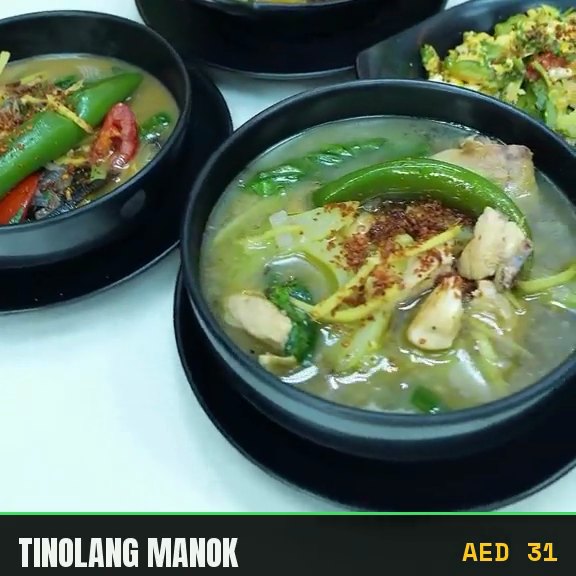 Tinolang Manok: Filipino Ginger Chicken SoupTinolang manok is chicken simmered in a clear broth built on ginger, garlic and onion, with a green vegetable and leaves added at the end. It is AED 31 at Pinoy Tambayan, the cheapest of the nine soup rows on the menu, and the dish Filipino households cook when somebody is unwell.
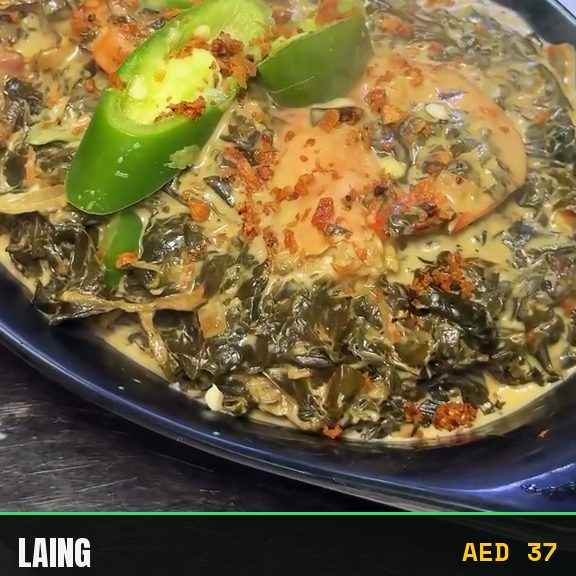 Laing: The Filipino Taro Leaf Dish From BicolLaing is dried taro leaves simmered in coconut milk with chilli and ginger until the sauce thickens, a Bicol dish that costs AED 37 at Pinoy Tambayan. It is one of nine vegetable rows on the menu and one of the few named by diners in their own reviews.
 Filipino Desserts at Pinoy Tambayan: Ube Halaya to Leche FlanPinoy Tambayan keeps six desserts on the printed menu at Al Barsha, from a five-dirham ice cream cone to a nineteen-dirham leche flan, plus halo halo as a seventh on its own guide. Every price and dish name below comes straight off the menu, not a guess.
Hungry now?
Open daily, 9:00 AM to 1:00 AM. No pork is served at Pinoy Tambayan. Free delivery within 5 km, AED 5 beyond, and no minimum order.
Order adobo on WhatsApp +971 4 328 2669 Book a table Get directions