
Dish guide ·
Kare Kare Explained: Filipino Peanut Stew Meant to Taste Plain
Kare kare is meat and vegetables simmered in a thick peanut sauce thickened with ground toasted rice. It is deliberately under-salted, because bagoong, salty fermented shrimp paste, is supposed to do the seasoning at the table rather than in the pot.
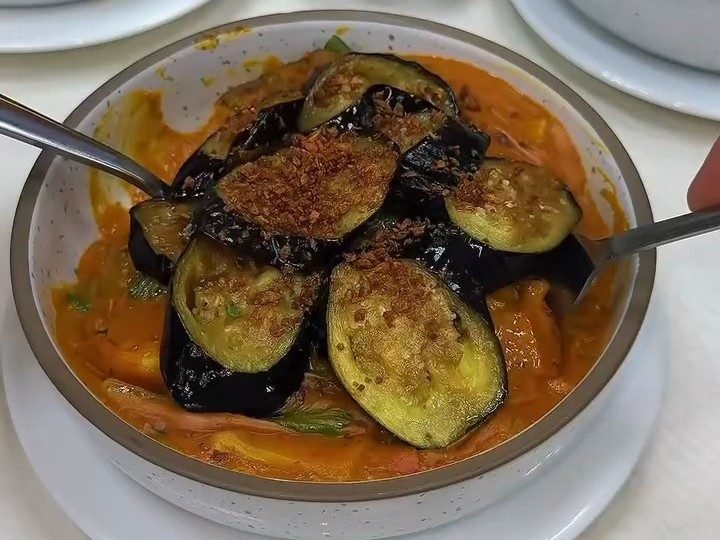
Kare kare is a Filipino stew of meat and vegetables in a thick, orange peanut sauce, thickened with ground toasted rice and coloured with annatto seed. The sauce is rich and mild rather than salty, and that is not an accident: kare kare is traditionally served with bagoong on the side, a salty fermented shrimp paste that each person stirs into their own portion. Season the pot and you take that decision away from the table. At Pinoy Tambayan in Al Barsha 1, Dubai, it is named in eight of our Google reviews, which for a dish this specific is a lot.
Why the stew arrives tasting mild
First-time eaters often take a spoonful of the sauce on its own, find it nutty and slightly sweet and almost unseasoned, and quietly conclude the kitchen forgot the salt. The kitchen did not. Kare kare is one of a small group of Filipino dishes built as a two-part system: a mild base and a strong condiment, combined by the eater in the ratio they want. The peanut sauce carries body, fat and toasted flavour. The bagoong carries salt, funk and a long fermented depth. Neither is a finished dish alone, and the version you end up eating is one you seasoned yourself, bite by bite. If you taste the sauce plain and stop there, you have eaten half the recipe.
What is actually in the sauce
Ground roasted peanuts, or peanut butter in most working kitchens, are the backbone. The thickening is ground toasted rice, which is what makes the sauce cling to meat instead of sliding off it, and it is also why kare kare sauce sets slightly as it cools rather than staying loose like a curry. Annatto seed, atsuete, supplies the orange colour without adding heat, so the shade tells you nothing about spice level. Garlic and onion go in at the start, and the meat is usually simmered long and slow first, then the peanut and rice go in near the end. Peanuts themselves reached the Philippines through the Manila galleon trade from the Americas, which puts a New World crop at the centre of a dish most people read as ancient and local.
The vegetables are structural, not garnish
A kare kare without vegetables is a peanut stew, not kare kare. The standard set is fixed enough that Filipinos notice immediately when one is missing, and each one is doing a specific job against a heavy sauce.
- Puso ng saging, banana heart: faintly bitter, slightly fibrous, and the item most often dropped outside the Philippines because it is the hardest to source.
- Talong, eggplant: cut in thick rounds, it goes soft and soaks up more sauce than anything else in the bowl.
- Sitaw, string beans: cut into finger lengths, and the only thing in the dish with real snap left in it.
- Pechay or bok choy: added last so the leaves wilt but the stems keep some bite, and it cuts the richness.
- Some kitchens add blanched cabbage or long beans depending on the market that morning, which is normal rather than a shortcut.
Which cut of meat, and why it varies
The version most often described as the original is oxtail, kare kareng buntot, prized because the collagen in the tail melts into the sauce over a long simmer and gives it a body that no amount of peanut can fake. Tripe and beef shank are equally traditional, often in the same pot. Because the cut changes what the dish costs and how long it takes, kitchens vary it by day and by market. Ask what is in the pot when you order rather than assuming: it is a normal question and the answer is the difference between a two-hour braise and a four-hour one. No pork is served at Pinoy Tambayan, so the pork hock version you may have eaten elsewhere is not one we cook.
Kare kare on our menu, and what to put next to it
Kare kare sits in the Adobo at Klasiko section of the printed menu, with the classics rather than the soups, because it eats like a main course over rice and not like a sabaw. Rice is not optional here, and the sauce is thick enough that garlic rice stands up to it better than plain.
Bagoong: what it is and how much to use
Bagoong alamang is tiny shrimp or krill salted and left to ferment for weeks or months until they break down into a thick, pink, intensely savoury paste. Most kitchens do not serve it raw: it is sautéed with garlic, sometimes with a little sugar and chilli, which softens the raw edge and turns it from a salt bomb into something closer to a seasoning relish. The correct amount is less than a newcomer expects. Start with roughly a quarter teaspoon stirred into one portion, taste, then add. It is far easier to add bagoong than to rescue a bowl you have oversalted, and the whole design of the dish assumes you will adjust upward. Bagoong is a shrimp product, so anyone avoiding shellfish should eat the stew plain and salt it normally.
Where the name came from, and why nobody agrees
There is no settled etymology, and anyone who tells you there is has picked a side. One account links kare to kari, curry, and points to Indian communities who settled in Cainta, Rizal in the colonial period. Another traces it to Kapampangan kitchens and reads it as a dish refined in Pampanga, a province with a long claim to being the culinary centre of Luzon. A third simply notes that kare kare in old Tagalog usage described the stewing itself. These are competing accounts rather than a known answer, and it is worth saying so plainly instead of repeating whichever version sounds most romantic. What is not disputed is the dish's status: it is a fiesta and Sunday-lunch dish, the kind that appears when there is a reason to cook something slow.
How to eat it without wrecking it
- Rice on the plate first, kare kare over it, bagoong on the rim of the plate and never stirred through the serving bowl. The shared pot stays unsalted for everyone else.
- Take a piece of meat, a piece of vegetable and rice in the same spoonful. The dish is balanced across the bowl, not inside any single component.
- If it tastes flat after bagoong, add a squeeze of calamansi rather than more paste. The sourness lifts peanut fat in a way more salt cannot.
- Eat the oxtail with your hands if there is a knuckle involved, which is what most Filipino families do and what our kamayan guide covers properly.
- Ordering it for delivery is fine, but keep the bagoong sealed until the food is plated, or it seasons the whole container in transit.
Kare kare for a table, and for thirty people
Kare kare is a sharing dish by construction: one pot in the middle, everyone seasoning their own plate to a different strength, which is why it survives a table where one person wants it salty and another does not. It also holds well on a buffet line, because the rice-thickened sauce does not split the way a cream sauce would over an hour of service. That makes it a straightforward choice for a catering order for thirty people or more, provided the bagoong goes out in its own bowl with a small spoon rather than being stirred through in the kitchen.
Is it a good first Filipino dish?
Yes, with one warning. The peanut sauce is familiar to anyone who has eaten satay or a West African groundnut stew, so the base is easy to like on a first try. The bagoong is the part that surprises people, and it is genuinely pungent on its own. Treat it as an optional dial rather than a requirement and the dish is very approachable. If you would rather have a whole first order planned out instead of one dish, we set out five things worth ordering on a first visit.
There is also a case for eating kare kare on the second visit instead, once the sour and savoury range of the sinigang family has made sense.
Kare kare questions we get asked
What is kare kare?
A Filipino stew of meat and vegetables in a thick peanut sauce thickened with ground toasted rice and coloured with annatto. It is served with bagoong, a salty fermented shrimp paste, on the side.
Why does kare kare taste bland?
It is meant to. The salt comes from the bagoong you stir in yourself, so the pot stays mild and every person at the table seasons their own portion to taste.
What is bagoong?
Tiny shrimp or krill salted and fermented into a thick savoury paste. It is usually sautéed with garlic before serving, which rounds off the sharpness.
Can I eat kare kare without bagoong?
Yes. Salt it normally instead, or add a squeeze of calamansi. Anyone avoiding shellfish should skip the bagoong entirely, since it is a shrimp product.
Is kare kare spicy?
No. The orange colour comes from annatto seed, which is a colouring rather than a chilli. Any heat comes from the bagoong if it was made with chilli.
What meat is in your kare kare?
The cut varies with the market, usually oxtail, tripe or beef shank. Ask when you order and the kitchen will tell you what is in the pot that day. No pork is served at Pinoy Tambayan.
Does kare kare come with rice?
Every main dish includes one free rice. Plain rice and garlic rice are on the menu as separate rows if you want extra, and the thick sauce takes garlic rice well.
We are opposite Dubai International Academy in Al Barsha 1, open 9:00 AM to 1:00 AM every day, rated 4.5 on Google. Order it for the table, put the bagoong in the middle, and let everyone find their own level.
Straight from our Google reviews
“The pancit canton or mix oh la la la also Kare Kare Loved it !... genuine kabayan taste! In short panlasang pinoy😁 Best Resto! Try eat!”
Copied word for word. Read all 558 five-star reviews
More from the Dining Guide
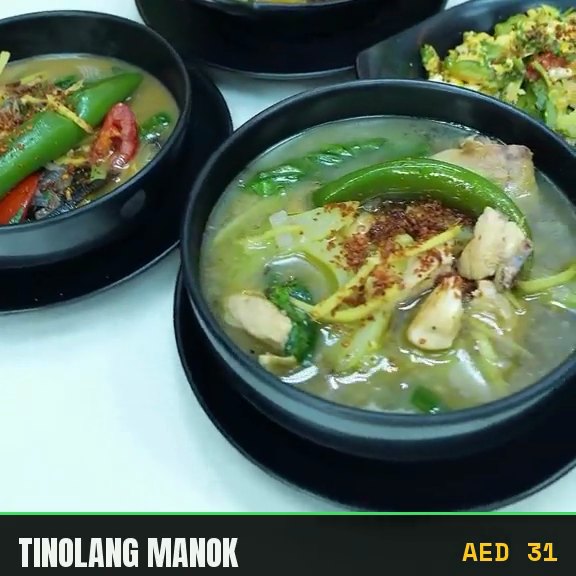 Tinolang Manok: Filipino Ginger Chicken SoupTinolang manok is chicken simmered in a clear broth built on ginger, garlic and onion, with a green vegetable and leaves added at the end. It is AED 31 at Pinoy Tambayan, the cheapest of the nine soup rows on the menu, and the dish Filipino households cook when somebody is unwell.
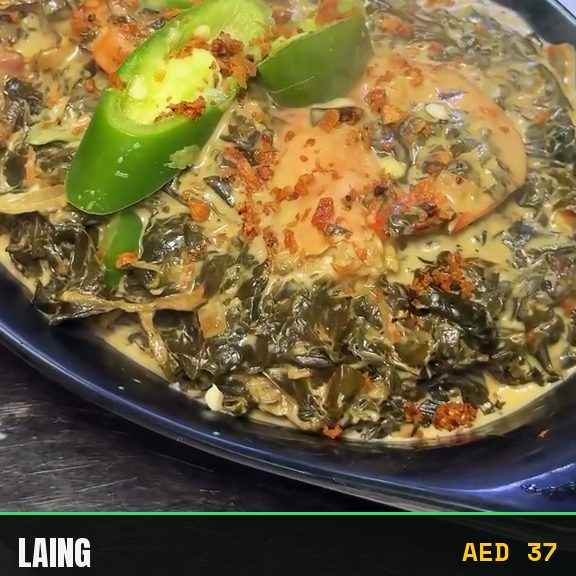 Laing: The Filipino Taro Leaf Dish From BicolLaing is dried taro leaves simmered in coconut milk with chilli and ginger until the sauce thickens, a Bicol dish that costs AED 37 at Pinoy Tambayan. It is one of nine vegetable rows on the menu and one of the few named by diners in their own reviews.
 Filipino Desserts at Pinoy Tambayan: Ube Halaya to Leche FlanPinoy Tambayan keeps six desserts on the printed menu at Al Barsha, from a five-dirham ice cream cone to a nineteen-dirham leche flan, plus halo halo as a seventh on its own guide. Every price and dish name below comes straight off the menu, not a guess.
Hungry now?
Open daily, 9:00 AM to 1:00 AM. No pork is served at Pinoy Tambayan. Free delivery within 5 km, AED 5 beyond, and no minimum order.
Order kare kare on WhatsApp +971 4 328 2669 Book a table Get directions