
Dish guide ·
Arroz Caldo and Goto: Filipino Rice Porridge
Arroz caldo is Filipino rice porridge simmered in a ginger and garlic chicken broth until the grains break down. Goto is the same bowl built on tripe instead of chicken.

Arroz caldo is a Filipino rice porridge: rice simmered in a ginger and garlic chicken broth until the grains break down and thicken their own liquid, then finished with toasted garlic, spring onion, a boiled egg and a squeeze of calamansi. Goto is the same porridge built on tripe instead of chicken. Both belong to lugaw, the broad Filipino word for rice cooked soft in liquid, and both are eaten with a spoon out of a bowl rather than ladled over rice. At Pinoy Tambayan in Al Barsha 1, Dubai, arroz caldo and goto sit in the Noodle is Life section of the menu, and both carry the best seller mark on our own printed menu.
Lugaw, arroz caldo, goto: the difference in one line
Lugaw is the family and the other two are members of it. Plain lugaw is rice cooked soft in lightly seasoned water with nothing much added, and it is deliberately austere. Arroz caldo adds chicken and a heavy hand of ginger, and takes its yellow from kasubha, the dried safflower threads that tint a broth without contributing much flavour of their own. Some kitchens reach for turmeric instead, which colours more strongly and tastes faintly earthy where kasubha tastes of almost nothing. Goto swaps the chicken for tripe, simmered long enough to go tender, and is usually the more heavily garlicked of the two. Everything else is shared: the ginger base, the fried garlic on top, the egg, the calamansi. That same ginger base carries the other dish Filipinos reach for when somebody is unwell, tinolang manok, where the ginger goes into a clear chicken broth instead of into rice.
The name is Spanish, the technique is Chinese
Arroz caldo is two Spanish words, arroz for rice and caldo for broth, wrapped around a method that is plainly congee: rice cooked far past tenderness until its own starch does the thickening. That combination is the short version of Filipino cooking in general, where a great deal of the technique arrived through Chinese trade and a great deal of the vocabulary arrived through Spanish administration. Goto is named for the tripe itself. This page will not name a date or a first cook for either dish, because the accounts that do are attributions rather than records, and a food page that invents its own history is worth less than one that says only what it can stand behind.
What goes on top, and why you add it yourself
A bowl of lugaw arrives finished but not fully seasoned, and that is the design rather than an oversight. The porridge is mild on purpose because the sharpness is meant to be built at the table by the person eating it: patis, the Filipino fish sauce, for salt, calamansi for acid, chilli for heat, and more toasted garlic than feels sensible, because the garlic is half the reason anyone orders it. Filipino food does this repeatedly. The pot builds body, the table builds edge. Start with less patis than you think you want, because the broth already carries salt and the calamansi is doing more of the work than the fish sauce is.
What sits beside a bowl of lugaw here
Prices come off the live menu rather than being typed into this page, so the cards below show what the kitchen is charging today, VAT included. Arroz caldo and goto sit beside the pancit rows, and two of the things Filipinos commonly put next to a bowl of lugaw are on our appetiser list: something salty and crunchy to break the softness, and something you can eat with your fingers between spoonfuls.
If you are choosing between a bowl of porridge and a bowl of noodles on the same visit, the difference is what does the thickening: rice starch releasing itself here, a deliberate starch slurry in the thick noodle gravy from Batangas. One is soft all the way through, the other has something to chew.
The pairing we cannot put next to it
Tokwa't baboy, fried tofu and pork belly dressed in vinegar and soy, is the classic partner to a bowl of goto in the Philippines. It is the one thing named on this page that you will not find on our menu. No pork is served at Pinoy Tambayan. If that pairing is the one you grew up with, ours will read differently to you, and it is fairer to say so here than to let you discover it at the table. Chicken skin does a comparable job in the bowl's favour: salt, crunch and fat set against something soft.
Eating it the way it is meant to be eaten
- Stir the bowl once when it lands. The fried garlic floats and the heaviest starch settles, and the first spoonful should be a mix of both rather than one or the other.
- Break the egg into the porridge instead of eating it on its own. The yolk is a seasoning, and it thickens the bowl a second time.
- Add the patis first and the calamansi last, so you can taste what the salt has already done before you make the bowl sour as well.
- Season in stages. You can add fish sauce to a porridge and you cannot take it back out again.
- Eat it hot, and eat it first if it has travelled. Lugaw keeps thickening as it cools and the rice keeps drinking the broth, so a bowl that stood for half an hour is a denser dish than the one that left the kitchen. That is the honest caveat for delivery.
Why it turns up at both ends of the day
Lugaw is what Filipinos eat when the day is either starting or refusing to end, and it is the standard thing to put in front of someone who has been ill. Our kitchen runs from nine in the morning until one the following morning, which puts a bowl of arroz caldo comfortably inside both of those windows, and it belongs on the same late list as the breakfast sets we set out in the guide to eating here after dark. In Dubai the trigger is almost never the weather. It is a night shift ending, a long drive back across town, an over-cooled room, or a Friday that ran later than anyone planned.
Is lugaw a good first Filipino dish?
It is a gentle one, which is exactly what makes it a better second than a first. Nothing about arroz caldo is difficult for a newcomer: it is savoury, soft, mildly gingered and immediately legible to anyone who has eaten congee or a loose risotto. What it is not is representative, because it sits at the comforting end of a cuisine whose signature note is sour and sharp. That is why our five things worth ordering on a first visit opens somewhere else entirely. Goto is the braver of the two, and tripe is usually the part a newcomer needs a second visit to reach.
Arroz caldo and goto questions we get asked
What is arroz caldo?
A Filipino rice porridge cooked with chicken, ginger and garlic until the rice breaks down and thickens the broth. It is finished with toasted garlic, spring onion, a boiled egg and calamansi, and eaten with a spoon.
What is the difference between arroz caldo and goto?
Arroz caldo is built on chicken and goto on tripe. The rice base, the ginger, the fried garlic and the toppings are the same in both, and goto is usually the more strongly garlicked of the two.
Is lugaw the same thing as arroz caldo?
Lugaw is the general word for rice cooked soft in liquid. Plain lugaw has nothing much added to it. Arroz caldo and goto are both lugaw with a meat and a heavy ginger base.
Why is arroz caldo yellow?
The colour comes from kasubha, dried safflower threads, or from turmeric where a kitchen prefers it. Kasubha gives colour with very little flavour, turmeric gives both.
Does goto contain pork?
No pork is served at Pinoy Tambayan. Tokwa't baboy, the usual pork and tofu side for goto, is not on our menu for the same reason.
Is arroz caldo spicy?
Not as it arrives. Any heat is what you add at the table from the chilli, alongside the fish sauce and the calamansi, so you set the level yourself.
Can I order arroz caldo late at night?
Yes. The kitchen runs from 9:00 AM to 1:00 AM every day, and lugaw is one of the things most often ordered at either end of that stretch.
We are opposite Dubai International Academy in Al Barsha 1, open 9:00 AM to 1:00 AM every day, rated 4.5 on Google. Come in early with a bowl and a coffee, or come in near closing and pretend it is early.
Straight from our Google reviews
“Tried their arroz caldo before and it was so solid.”
Copied word for word. Read all 558 five-star reviews
More from the Dining Guide
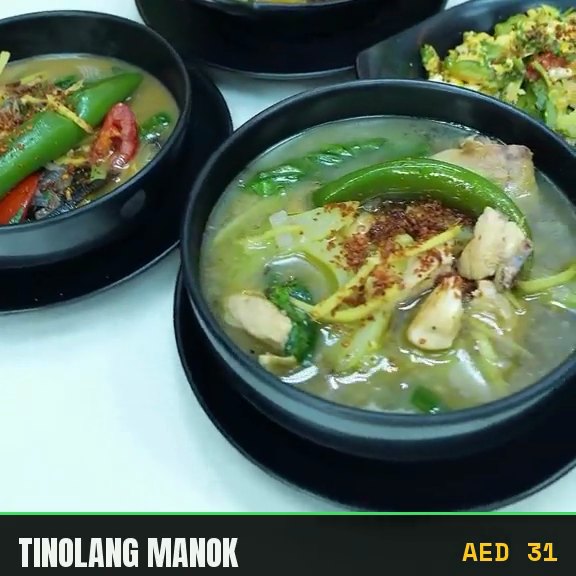 Tinolang Manok: Filipino Ginger Chicken SoupTinolang manok is chicken simmered in a clear broth built on ginger, garlic and onion, with a green vegetable and leaves added at the end. It is AED 31 at Pinoy Tambayan, the cheapest of the nine soup rows on the menu, and the dish Filipino households cook when somebody is unwell.
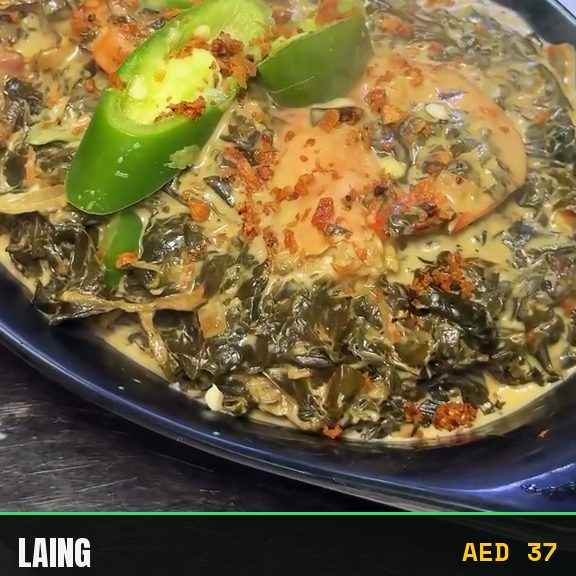 Laing: The Filipino Taro Leaf Dish From BicolLaing is dried taro leaves simmered in coconut milk with chilli and ginger until the sauce thickens, a Bicol dish that costs AED 37 at Pinoy Tambayan. It is one of nine vegetable rows on the menu and one of the few named by diners in their own reviews.
 Filipino Desserts at Pinoy Tambayan: Ube Halaya to Leche FlanPinoy Tambayan keeps six desserts on the printed menu at Al Barsha, from a five-dirham ice cream cone to a nineteen-dirham leche flan, plus halo halo as a seventh on its own guide. Every price and dish name below comes straight off the menu, not a guess.
Hungry now?
Open daily, 9:00 AM to 1:00 AM. No pork is served at Pinoy Tambayan. Free delivery within 5 km, AED 5 beyond, and no minimum order.
Order arroz caldo on WhatsApp +971 4 328 2669 Book a table Get directions