
Dish guide ·
Lomi: The Thick Filipino Noodle Gravy From Batangas
Lomi is thick Filipino egg noodles in a starch-thickened gravy with beaten egg stirred through, not a clear soup. It comes from Batangas and is eaten with a spoon.
Lomi is a Filipino noodle dish of thick fresh egg noodles served in a gravy rather than a broth: the liquid is thickened with a starch slurry until it coats the back of a spoon, and beaten egg is stirred through at the last moment so it sets into soft ribbons. It is not a noodle soup, and that difference is the whole point of the dish. Lomi belongs to Batangas, the province south of Manila, where shops exist that sell nothing else. At Pinoy Tambayan in Al Barsha 1, Dubai, it sits in the Noodle is Life section of the menu, five of our Google reviewers name it by name, and it is the dish in our most watched kitchen video.
Gravy, not broth: what makes lomi lomi
Lift a spoonful and tilt it. A noodle soup runs straight off the edge. Lomi does not: it slides slowly and leaves a film behind, because the stock has been thickened until it has body. That one decision changes everything downstream. The noodles do not float, they sit suspended. The seasoning clings to them instead of collecting at the bottom of the bowl. Heat is held far longer than a thin broth would hold it, which is why a bowl of lomi is still genuinely hot ten minutes after it lands in front of you. The beaten egg goes in at the very end, off the rolling boil, so it sets into soft strands rather than dispersing into cloud. You eat it with a spoon and use the fork only to lift.
Where the dish comes from
Lomi is Batangueno food. The province south of Manila is where the dish is embedded deeply enough in daily life to have produced its own building type: the lomihan, a shop that sells lomi and very little else, open early for the people coming off a night shift and late for the ones going on to one. The name arrives through Hokkien, the Chinese dialect spoken by the traders and migrants who shaped a large part of the Filipino noodle repertoire, and the ancestor dish is a braised, thickened noodle rather than a soup. Past that point the record thins out. Specific origin stories circulate, naming particular cooks and particular decades in Lipa, and they are attributions rather than settled history, so this page will not repeat one as though it were fact. What is not in dispute is the province.
How it differs from every other noodle on the menu
Filipino noodle dishes are named after the noodle and the sauce follows from it, which is why our guide to bihon, canton and malabon is worth reading beside this one. Lomi is the outlier in that family. It is the only one you would call wet, and the only one where the liquid is the dish itself rather than a dressing applied to something else.
- Against pancit bihon: bihon is dry. Thin rice noodles tossed through a wok, no standing liquid, eaten off a plate. Lomi is the opposite proposition in every respect except that both are noodles.
- Against pancit canton: canton is a stir fry, cooked hot and fast with soy and a firmer bite. Lomi is simmered and thickened. Canton also has no supplier at the moment, so its menu card asks you to check with us before ordering rather than pretending otherwise.
- Against pancit malabon: malabon carries a thick orange shrimp sauce, so it is the closest of the three for sheer weight, but that sauce coats a plated noodle instead of surrounding it. Malabon is eaten with a fork, lomi with a spoon.
- Against mami: mami is the actual Filipino clear-broth noodle soup. If you order lomi expecting mami you will be surprised, and the gravy is the surprise.
Lomi on our menu, and what sits beside it
Lomi sits in the Noodle is Life section, next to the pancit rows and the two rice porridges. Prices come off the live menu rather than being typed into this page, so the cards below show what the kitchen is charging today, VAT included.
The sawsawan does the seasoning
A bowl of lomi arrives deliberately under-seasoned, and if you eat it exactly as it comes you may find it mild to the point of flat. That is the design rather than an oversight. Lomi is finished at the table with a sawsawan, a small dish of soy sauce with calamansi squeezed into it and chilli added to taste, and the eater spoons it in a little at a time until the bowl tastes the way they want it to. Filipino food does this repeatedly: the kitchen builds body, the table builds sharpness. Start with less soy than feels right, because the gravy already carries salt and the calamansi is doing more of the work than the soy is. Add, taste, add again.
How to eat it before it sets
- Stir the whole bowl once when it lands. The egg and the heaviest gravy settle towards the bottom, and the first spoonful should not be the thin part.
- Season in stages from the sawsawan instead of emptying it in. You cannot take soy sauce back out of a gravy.
- Spoon for the liquid, fork only to lift a noodle clear of it. Most Filipinos use both and commit to neither.
- Eat it hot. Lomi thickens further as it cools and the noodles keep drinking the gravy, so a bowl left standing for twenty minutes is a stodgier dish than the one that was served.
- That last point is the honest caveat for delivery: lomi travels less gracefully than a dry pancit, and it is better eaten in the room it was cooked in. If it does travel, eat it first rather than last.
Why it turns up late at night
Lomi is heat you can eat. That makes it a cold-weather dish in the Philippines and, more oddly, an air-conditioning dish in Dubai, where an over-cooled room at one in the morning produces the same craving a Batangas rainstorm does. Our kitchen runs until one, and lomi belongs to the same late list as the rice porridges, which we set out in the guide to eating here after dark. It is also filling in a way that suits somebody coming off a shift who has no appetite for assembling a meal out of three separate dishes.
What is not in ours
Lomi elsewhere is often built on pork: liver stirred through it, chicharon crumbled over the top, kikiam sliced into the bowl. No pork is served at Pinoy Tambayan. If the pork version is the one you grew up with, ours will read differently to you, and it is fairer to say so on this page than to let you discover it from the bowl. For what is in it on any given day, ask when you order. The kitchen will tell you, and that is a better answer than anything a web page can promise in advance.
Is lomi a good first Filipino dish?
It is a reasonable one, with a caveat. Nothing about lomi is difficult: it is savoury, mild, thick and immediately familiar to anyone who has eaten a Chinese braised noodle. What it is not is representative. Somebody eating Filipino food for the first time learns more from the sour and sharp end of the range than from the comforting end, which is why our five things worth ordering on a first visit does not open with it. Order lomi on a cold night or at the end of a long one. Order it second.
Lomi questions we get asked
What is lomi?
A Filipino noodle dish of thick egg noodles in a gravy thickened with starch, with beaten egg stirred through at the end. It comes from Batangas and is eaten with a spoon.
Is lomi a soup?
No. The liquid is thickened until it coats a spoon, so it behaves like a gravy rather than a broth. Mami is the Filipino clear-broth noodle soup, and it is a different dish.
What noodles are used in lomi?
Thick fresh egg noodles, often called miki. They are far softer and thicker than the thin rice noodles used in pancit bihon.
Is lomi spicy?
Not as it arrives. Any heat comes from the chilli you add to the soy sauce and calamansi at the table, so you set the level yourself.
Does lomi have pork in it?
No pork is served at Pinoy Tambayan. Versions elsewhere often use pork liver, chicharon or kikiam, which is worth knowing if you are comparing ours to one you have eaten before.
What is the sawsawan for?
It is the seasoning dish, usually soy sauce with calamansi and chilli. Lomi is served mild on purpose so that each person seasons their own bowl to taste.
Can I order lomi for delivery?
Yes, on the same order path as everything else on the menu. It keeps thickening as it cools, so eat it as soon as it arrives rather than saving it for last.
We are opposite Dubai International Academy in Al Barsha 1, open 9:00 AM to 1:00 AM every day, rated 4.5 on Google. Come in on a cold night, or on a night that only feels cold because the air conditioning is winning.
More from the Dining Guide
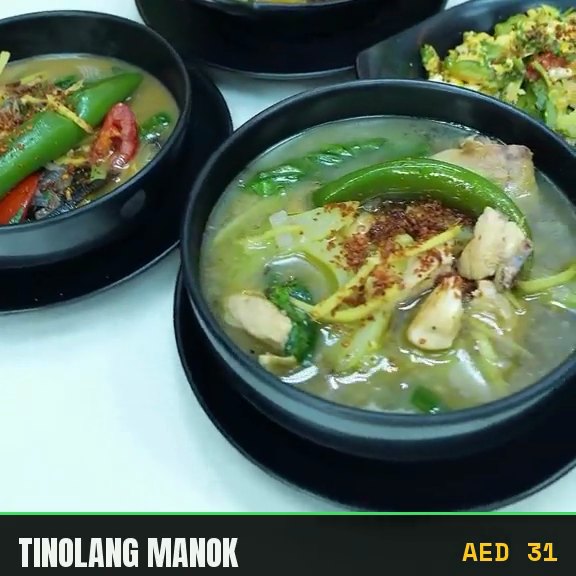 Tinolang Manok: Filipino Ginger Chicken SoupTinolang manok is chicken simmered in a clear broth built on ginger, garlic and onion, with a green vegetable and leaves added at the end. It is AED 31 at Pinoy Tambayan, the cheapest of the nine soup rows on the menu, and the dish Filipino households cook when somebody is unwell.
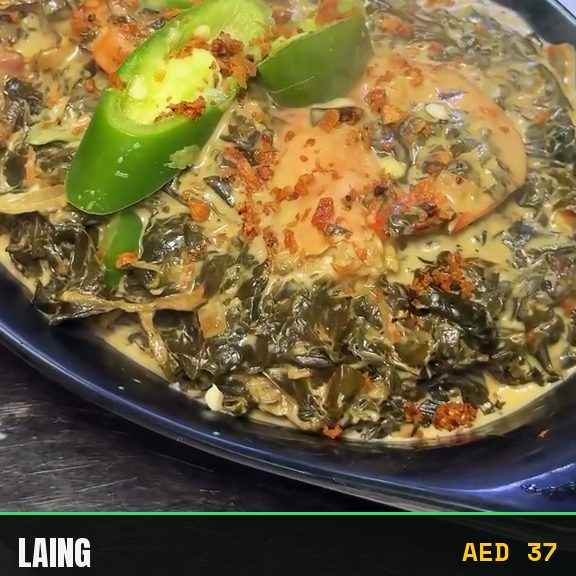 Laing: The Filipino Taro Leaf Dish From BicolLaing is dried taro leaves simmered in coconut milk with chilli and ginger until the sauce thickens, a Bicol dish that costs AED 37 at Pinoy Tambayan. It is one of nine vegetable rows on the menu and one of the few named by diners in their own reviews.
 Filipino Desserts at Pinoy Tambayan: Ube Halaya to Leche FlanPinoy Tambayan keeps six desserts on the printed menu at Al Barsha, from a five-dirham ice cream cone to a nineteen-dirham leche flan, plus halo halo as a seventh on its own guide. Every price and dish name below comes straight off the menu, not a guess.
Hungry now?
Open daily, 9:00 AM to 1:00 AM. No pork is served at Pinoy Tambayan. Free delivery within 5 km, AED 5 beyond, and no minimum order.
Order lomi on WhatsApp +971 4 328 2669 Book a table Get directions